

/fdata%2F3047213%2Favatar-blog-1104732428-tmpphpCAT9U5.jpeg)
250 años de corrupción sistémica en el Perú
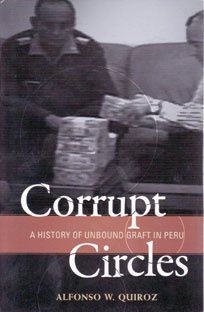 |
On cost and consecuences of 250 years of systemic corruption in Peru: Corrupt Circles


Corruption has existed since the earliest civilizations but documenting and writing its history has not been easy. In the case of Peru, tackling through detailed research the challenges to writing a history of corruption, one finds abundant evidence of structural corruption. This prevalent type of corruption is defined broadly as the persistent abuse of power for private gain. In successive phases, over a stretch of more than 250 years, systemic corruption seriously undermined Peru’s basic institutions and promising possibilities for development. To untangle this intricate knot Corrupt Circles follows the guiding threads left for posterity by courageous reformists and opponents of unchecked graft in a poor society. The book is intended to be read as a story of the perils of greed and abuse past and present.
In Peru, the interested mismanagement of the state and national resources inflicted endemic social harm over time. Evolving corrupt schemes and the networks of persons who implement them affected strategic sectors. Initially it was colonial mining and contraband trade that exhibited deep problems ascribed to rampant corruption. After independence similar hurdles afflicted republican guano income and public debt administrations often bribed by foreign contractors of public works and arms procurement. In the twentieth century corruption thrived under military dictatorial oppression, preyed on deals of oil exploitation, and most recently, drug interdiction. Corruption reached a zenith under the cover of gross undemocratic abuses during the infamous Fujimori-Montesinos regime.
The exposure of this hidden history leads to a reinterpretation of Peru’s evolution and a reevaluation of the importance of transparency and individual and collective efforts at critical reform. In our own times of global frauds and political corruption these insights apply beyond a single, albeit paradigmatic, Latin American country.
Corrupt Circles combines different tools of economic, political, and historical analysis to identify the costs and consequences of corruption in a developing society. The book particularly adopts and applies recent methodological breakthroughs by economists who conceive corruption as an obstacle for overall development. Only marginally does this analysis treat corruption solely through the angle of public perceptions, a fleeting standard for measuring it. The book’s main object is the hard evidence of corruption’s costs transpired in governmental and institutional malfunction, failure, and wasted opportunities.
Institutions as well as policies suffer costly biases if they are directed by corrupt officers or policy makers swayed through bribes rather than goals of efficiency. Certainly there continues to be a lively academic debate over these issues. Armed with a considerable arsenal of quantitative data, I venture to estimate the direct and indirect costs of graft in different cycles and government administrations in Peru.
On average corruption costs accounted for as high as 30 or 40 percent of Peru’s total public budget expenditures and 3 to 4 percent of gross domestic product. I confine most of these calculations to the sole appendix of the book, to avoid interrupting the main narrative built upon unraveling corruption scandals and the controversies they entailed.
The political underpinnings of corruption are evident through the almost perennial absence of checks to the executive branch of government. Despite constitutional blueprints, often violated, political practice in Peru has subjected the legislative and judicial branches to the influence or control of presidential power. Abuse of political power in a context of viceregal or caudillo patronage went hand in hand with the draining of scarce public resources for private or party benefit. Modern political parties involved in electoral democracy also profited from crooked means to obtain and maintain power. Political leaders and officers engaged in covert pacts and interested understandings with other political forces so as to buttress customary impunity.
Corruption can also encompass both continuity and variation in history. This is a key notion to understand the phenomenon of corruption. Each new cycle of corruption brings new means and schemes imbedded in technological and organizational changes. An illustration can be the public contracting of railway construction in the 1850s and 1860s. As this history of graft illustrates, corrupt and corrupting agents always found new and sophisticated ways to illegally funnel public resources into private hands. To visualize the changing nature of a paradoxically persistent encumbrance, the book adopts a long-term perspective.
The main historical sources I analyze are colonial treatises, official accounts and inquiries, diplomatic reports (from British, French, Peruvian, Spanish, and United States archives), legislative investigations, judicial trials, declassified documents, business records, memoirs, self-incriminating audio and video transcripts, journalistic accounts and investigations, among several other.
www.rorotoko.com/.../alfonso_quiroz_book_interview_corrupt_circles_history_unbound_graft_peru - En caché
As Peru prosecutes former president Alberto Fujimori and other alleged participants in state crimes, the country's longstanding culture of impunity is under ...books.google.com.pe/books?isbn=0801891280...
www.livinginperu.com/blogs/features/1415 - En caché
Alfonso W. Quiroz is professor of history, Baruch College and Graduate ... of four books on the history of financial institutions and corruption in Peru. ...books.google.com.pe/books?isbn=0739112252...


/http%3A%2F%2Fwww.contrainjerencia.com%2Fwp-content%2Fuploads%2F2014%2F07%2Ftimthumb.php_1.jpg)
/http%3A%2F%2Fwww.radio36.com.uy%2Fentrevistas%2F2014%2F08%2F01%2Fclip_image002_0546.jpg)
/http%3A%2F%2Fwww.radio36.com.uy%2Fentrevistas%2F2014%2F08%2F01%2Fclip_image002_0545.jpg)
/http%3A%2F%2Fimg.youtube.com%2Fvi%2FIq04dnHwpYc%2F0.jpg)
