

/fdata%2F3047213%2Favatar-blog-1104732428-tmpphpCAT9U5.jpeg)
Auguran demora en rescate de 29 cadáveres en mina neozelandesa
Podría tomar varias semanas antes de poder desenterrar los cadáveres, advirtió el jefe de la mina, Meter Whittall.
25 de noviembre de 2010, 10:20 Wellington, 25 nov (PL) El rescate de los cadáveres de los 29 trabajadores que quedaron atrapados en una mina de carbón del sur de Nueva Zelanda podría tardar semanas o meses, ante el peligro de nuevas explosiones. Los responsables de recuperar los cuerpos de los 29 obreros del yacimiento Pike River alertaron hoy acerca del posible retraso en el ingreso al lugar por la persistencia de gases tóxicos capaces de desencadenar otro estallido.Es el mismo escenario que la semana pasada. Incluso, aunque nos apresuremos puede llevar una semana o más hasta que se pueda acceder a la mina. Podría tomar varias semanas antes de poder desenterrar los cadáveres, advirtió el jefe de la mina, Meter Whittall.
Los 24 neozelandeses, dos británicos, dos australianos y un surafricano fueron declarados muertos la víspera, luego de casi seis días atrapados sin haber podido establecer contacto alguno con ellos.
El grupo de empleados quedó encerrado por una explosión que generó un flujo de gases tóxicos dentro de los túneles, lo cual hizo imposible implementar la operación de salvamento por el riesgo de un segundo estallido, como a la postre sucedió.
Las banderas ondearon a media asta este jueves como parte del duelo nacional decretado la víspera por el primer ministro John Key, quien se reunió con los familiares de las víctimas.
El peor accidente minero en la historia de Nueva Zelanda ocurrió en 1914, con un saldo de 43 muertos.
|
El desastre de la mina de carbón Brunner en Nueva Zelanda en 1896 |
26 March, 1896, Brunnerton, West Coast
Summary
Brunner Mine Disaster 26 March, 1896. The Brunner Mine disaster was the worst mining disaster in New Zealand’s history. A total of 65 miners died in the disaster, almost half of the Brunner underground work force.
Black damp, or choke damp: Miners’ name for a mixture of nitrogen and carbon dioxide. If there is not enough oxygen in the air, miners can suffocate.
What happened?
- The explorer Thomas Brunner had discovered a seam of good quality coal on the banks of the Grey River in July 1847 during his 1846-48 exploration of the area.
- The first load of coal left the West Coast in July 1864 by ship, but it was not until a railway to Greymouth had been built in 1876 that the Brunner coal fields really began to grow. Major harbour works at Greymouth in the 1880s also helped the shipping of coal to other parts of New Zealand.
- At about 9:30 am on the morning of 26 March, 1896, a sound like artillery fire was heard, and smoke was seen coming out of the pithead.
- The area of the Brunner Mine in 1896 was over 230 acres. There was no damage to the buildings at the entrance to the mine because the explosion was so deep into the mine.
- A crowd gathered while the manager and the underground engineer went down to check what had happened. When they did not return, miners from other shifts followed them, only to find the two men unconscious from black damp. The rescue party moved further into the diggings.
- Groups of rescuers came from Blackball, Greymouth, Westport, and other parts of the Coast as news of the disaster spread.
- From 11:00 am they began bringing out the bodies of the dead miners. But even as they worked, the rescuers were affected by the gas in the air and the lack of ventilation, and could only work in short shifts. Many were brought out unconscious, misleading the onlookers into thinking that some of the original miners were being brought out alive.
- As groups moved deeper into the mine they found signs of a huge explosion. The railway line and trucks were twisted and smashed, and some of the bodies recovered were so badly mutilated that they had to be identified by their clothing.
- By 2:00 pm the next day, 64 bodies had been brought out of the mine. It could be seen that those away from the point of explosion had been trying to escape and had been suffocated by the black damp. It took a further three days to locate the last body. A total of 65 miners died in the disaster, almost half of the Brunner underground work force.
How many died? 65 men.
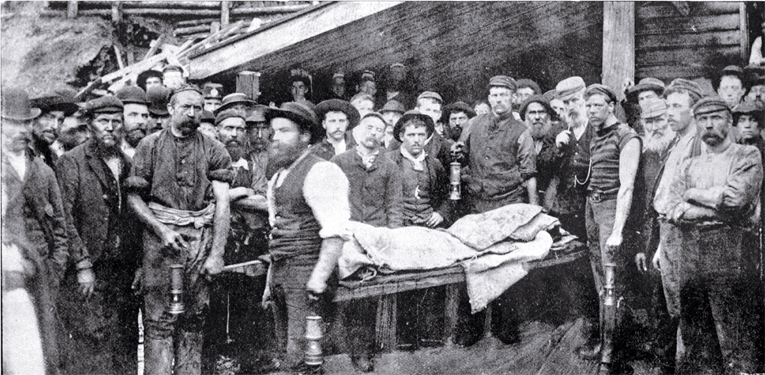
Rescuers begin the job of removing bodies within the mine, Brunner mining disaster [1896]
On 26 Mar. 1896 disaster struck as an explosion at the mouth of the main drive of the mine left 67 miners entombed. Round the clock rescue parties took several days to unearth the bodies of the men, some being so badly mutilated that only clothing or a distinguishing mark could make for identification. The mine had been idle for four or five days and it was presumed that gas had accumulated to a dangerous level. Fifty bodies were interred in the Stillwater Cemetery, one mass grave containing thirty three. The remainder were buried in the Greymouth Cemetery. See Disaster at Brunner : the coalmine tragedy at Brunnerton N.Z., 2 March 1896 / Brian Wood
Included in the photograph are Constable Beattie, John Coulthard, Dan Young, Joe Strong, Mr McKenzie, Samuel Kean, A. Smith, Crofter McKenzie, William Stevens, Mr O’Donnell, Joe Noble and Jack Southard.
Included in the photograph are Constable Beattie, John Coulthard, Dan Young, Joe Strong, Mr McKenzie, Samuel Kean, A. Smith, Crofter McKenzie, William Stevens, Mr O’Donnell, Joe Noble and Jack Southard.
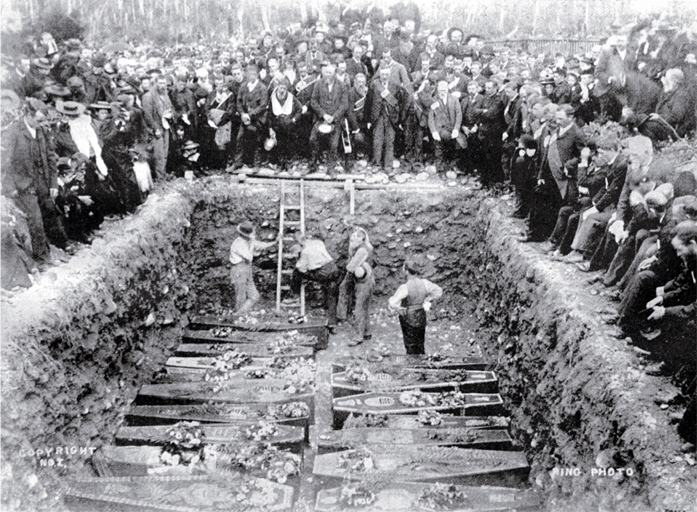
Mass funeral service for the victims of the Brunner mining disaster
On 26 Mar. 1896 disaster struck as an explosion at the mouth of the main drive of the mine left 67 miners entombed. Round the clock rescue parties took several days to unearth the bodies of the men, some being so badly mutilated that only clothing or a distinguishing mark could make for identification. The mine had been idle for four or five days and it was presumed that gas had accumulated to a dangerous level. Fifty bodies were interred in the Stillwater Cemetery, one mass grave containing thirty three. The remainder were buried in the Gremouth Cementery.

A rescuing party, Brunner mining disaster [1896] On 26 Mar. 1896 disaster struck as an explosion at the mouth of the main drive of the mine left 67 miners entombed. Round the clock rescue parties took several days to unearth the bodies of the men, some being so badly mutilated that only clothing or a distinguishing mark could make for identification. The mine had been idle for four or five days and it was presumed that gas had accumulated to a dangerous level. Fifty bodies were interred in the Stillwater Cemetery, one mass grave containing thirty three. The remainder were buried in the Greymouth Cemetery. See Disaster at Brunner : the coalmine tragedy at Brunnerton N.Z., 2 March 1896 / Brian Wood
Included in the photograph are A. Smith, Dan Southard, John Noble, Mr McKenzie, William Stevens, J. Ward, Crofter McKenzie, Tom Bland, Joe Strong, Constable Beattie, Sam Keane, John Coulthard, Dan Young and Charles Guthbert
Brunner Mine 26 March, 1896 – New Zealand Disasters – Kids …Brunner Mine Disaster 26 March, 1896. The Brunner Mine disaster was the worst mining disaster in New Zealand’s history. A total of 65 miners died in the …
christchurchcitylibraries.com/…/nzdisasters/brunner.asp – En caché – Similares
- Brunner mine disaster kills 65 – Today in History | NZHistory.net …1896 Brunner mine disaster kills 65. At 9.30 a.m. an explosion was heard from the … Brunner coal mine disaster memorialNew Zealand disasters timeline …
www.nzhistory.net.nz/timeline&new_date=26/03 – En caché - New Zealand disasters timeline | NZHistory.net.nz, New Zealand …1896 Brunner mine accident: On 26 March an explosion at Brunner, West Coast …
www.nzhistory.net.nz › … › Disasters – En caché – Similares - Coal and coal mining – Brunner mine disaster, 1896 – Te Ara … Brunner mine disaster, 1896 (1st of 3). The photograph shows one of the first … The worst loss of life in New Zealand mining occurred at this mine on 26 …
www.teara.govt.nz/en/coal-and-coal-mining/7/…/1 – En caché – Similares
1896 Brunner mine disaster kills 65
At 9.30 a.m. an explosion was heard from the Brunner mine in Westland’s Grey Valley. Two men sent to investigate were later found unconscious from black damp, a suffocating mixture of nitrogen and carbon dioxide. By 11 a.m. rescuers began bringing out bodies. Those involved in the rescue very nearly became victims due to the noxious gases and had to be carried out. A total of 65 miners were killed by the choking gas – almost half of Brunner’s underground workforce. This remains New Zealand’s deadliest industrial accident.
The official enquiry determined that the cause was the detonation of a charge in a part of the mine where no one should have been working. Some experienced miners disagreed with the findings. They maintained that firedamp – methane gas produced by coal – had accumulated and not been cleared due to an ineffective ventilation system.
Image: Rescue party at Brunner (Christchurch City Libraries)
——————
/http%3A%2F%2Fchristchurchcitylibraries.com%2FKids%2FNZDisasters%2Fimages%2FHeader.gif)
http://www.nzhistory.net.nz/culture/new-zealand-disasters/timeline
- 1879 Kaitangata mine accident - On 21 February, 34 miners were killed in an explosion at the Kaitangata coal mine in Otago. Find out more.
1896 Brunner mine accident - On 26 March an explosion at Brunner, West Coast, killed 65 coal miners in New Zealand’s worst mining disaster. Find out about this and other mining accidents on Te Ara.
- 1914 Huntly mine accident On 12 September 43 coal miners were killed in an explosion at Ralph’s Mine, Waikato.
- 1926 Dobson mine accident On 3 December an explosion at the Dobson coal mine on the West Coast killed nine miners.
- 1939 Huntly mine accident On 24 September 11 men were asphyxiated by carbon monoxide at the Glen Afton coal mine, Huntly.
- 1967 Strongman mine accident On 19 January an explosion at the Strongman coal mine, near Greymouth, killed 19 miners.
- 2010 Pike River mine accident Two explosions on 19 and 24 November result in the deaths of 29 coalminers at the Pike River mine on the West Coast. It is this country’s worst mining disaster since 1914.
 Mining Accidents
/http%3A%2F%2Fchristchurchcitylibraries.com%2FKids%2FNZDisasters%2Fimages%2FDisastersMap.gif)
Publicidad
Compartir este post


Para estar informado de los últimos artículos, suscríbase:
/http%3A%2F%2Fwww.contrainjerencia.com%2Fwp-content%2Fuploads%2F2014%2F07%2Ftimthumb.php_1.jpg)
/http%3A%2F%2Fwww.radio36.com.uy%2Fentrevistas%2F2014%2F08%2F01%2Fclip_image002_0546.jpg)
/http%3A%2F%2Fwww.radio36.com.uy%2Fentrevistas%2F2014%2F08%2F01%2Fclip_image002_0545.jpg)
/http%3A%2F%2Fimg.youtube.com%2Fvi%2FIq04dnHwpYc%2F0.jpg)
Comentar este post
