

/fdata%2F3047213%2Favatar-blog-1104732428-tmpphpCAT9U5.jpeg)
/http%3A%2F%2Fwww.aeronoticias.com.pe%2Fnoticiero%2Fimages%2Fstories%2F10%2F10%2F031010%2Fsusana-villar--n.jpg)
/http%3A%2F%2Fgsendon.paginaswebsjl.com%2Farchivos%2Fgsendon_file_9l2_CARLIN_grande100909.jpg)
/http%3A%2F%2Fwww.economist.com%2Fsites%2Fdefault%2Ffiles%2Fimages%2Fimages-magazine%2F2010%2F09%2F25%2Fam%2F20100925_amp001.jpg) |
A PINK tide of left-wing election victories may have washed over much of Latin America in the past decade, but Peru has been a notable exception. The reasons are not hard to discern. The far left was discredited by the terrorist violence unleashed by the Maoist Shining Path and Marxist Túpac Amaru guerrillas in the 1980s and 1990s. Just as disastrously, the left’s economic recipes produced hyperinflation and slump during the presidency of Alan García between 1985 and 1990. In contrast, the economy has grown vigorously for most of the past 15 years under right-of-centre presidents, currently the self-same Mr García, now reinvented as a neoconservative.
But is Peru’s left at last poised for a revival? If the opinion polls are correct, Susana Villarán, a human-rights activist who is standing for a new left-wing party called Fuerza Social (Social Force), will be elected mayor of Lima, the capital, on October 3rd. It would be the first time the left has won the capital since 1983.
Ms Villarán’s rise in the polls has been sudden and unexpected. A popular conservative candidate, Alex Kouri, was disqualified on a technicality. That was expected to benefit Lourdes Flores, another conservative who twice ran for president. But support for Ms Flores, a lawyer, began to slip when it was revealed that she had advised a convicted drug trafficker. Then tapes surfaced of phone calls in which, bizarrely, she said she wasn’t very interested in being mayor anyway. Such illegal telephone-tapping has besmirched Peruvian politics since it was deployed against opponents by Alberto Fujimori, a conservative president who revived the economy in the 1990s but is now in jail.
Ms Villarán is a moderate who promises clean and efficient municipal government. But if she wins, and if her allies do well in other cities and regions next month, that will cast uncertainty over the outcome of a presidential election due in April. In 2006 Mr García won only narrowly against Ollanta Humala, a populist former army officer who sympathised with Venezuela’s Hugo Chávez. Since then Mr Humala’s star has waned. Partly because of the economy’s strong growth, he has tried to repackage himself as a centrist. Even so, the polls suggest that he would be easily beaten in April by several centrist and conservative contenders, including Mr Fujimori’s daughter, Keiko.
Ms Villarán does not support Mr Humala, but some in her party do. As the presidential vote draws nearer, the left’s support may rise. If it does, it will be because of the flaws of the right as much as the virtues of the left. Mr García has failed to stamp out rampant corruption in his party, and his government has not done as much as it might to use increased tax revenues to make social programmes more effective. Peruvians are still searching for the politician who can combine economic growth with clean, fair and effective government.
 |
Perú visto desde Londres
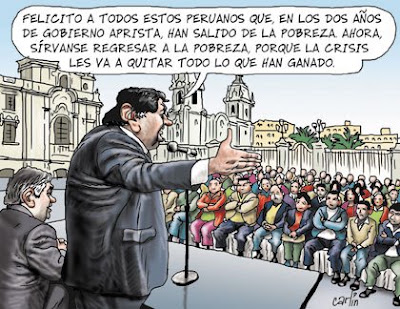 |
Alan García y sus adictos proclaman que el Perú es visto en el mundo entero como un país ejemplar, exitoso en lo económico y digno de servir de ejemplo en la lucha contra la pobreza.
Lo malo es que ellos son los únicos que se lo creen.El Financial Times de Londres acaba de publicar un artículo del economista John Crabtree, investigador asociado de la Universidad de Oxford, quien sostiene que en las elecciones generales del Perú en el 2011 saldrá elegido de todas maneras un partidario del libre mercado (Keiko Fujimori, Alejandro Toledo o Luis Castañeda), pero que en cualquier caso “es necesario atender la dimensión social del gobierno, invertir más en ello (…) no sólo porque es ético, moral y justo, sino para darle sostenibilidad al crecimiento económico”.
En efecto, ¿qué puede ocurrir con la industria textil o el agro dedicados al consumo interno, si el poblador urbano percibe salarios esqueléticos y si el agricultor pequeño o mediano es convertido en peón de los crecientes latifundios de costa, sierra y selva?


/http%3A%2F%2Fwww.contrainjerencia.com%2Fwp-content%2Fuploads%2F2014%2F07%2Ftimthumb.php_1.jpg)
/http%3A%2F%2Fwww.radio36.com.uy%2Fentrevistas%2F2014%2F08%2F01%2Fclip_image002_0546.jpg)
/http%3A%2F%2Fwww.radio36.com.uy%2Fentrevistas%2F2014%2F08%2F01%2Fclip_image002_0545.jpg)
/http%3A%2F%2Fimg.youtube.com%2Fvi%2FIq04dnHwpYc%2F0.jpg)
