

/fdata%2F3047213%2Favatar-blog-1104732428-tmpphpCAT9U5.jpeg)
Secession: 2° Republica de Vermont / Vermont 2° Republic
/http%3A%2F%2Fwww.nerepublican.com%2Fwp-content%2Fuploads%2F2007%2F10%2Ffree-vermont-flag1.jpg)

La secesión es una opción política legal que busca la separación del gobierno central. No se trata de derrocar al gobierno o rebelarse, sólo se trata de retirarse. No es un movimiento para derrocar al gobierno en su conjunto, solamente se trata de que la gente está haciendo ejercicio de su derecho a salir de su asociación anterior. La secesión no se limita a los Estados, también ocurre con los condados, ciudades y barrios. El concepto de la secesión se asocia a menudo con la anulación (nulificación).
Nulificación - la nulificación se produce cuando un órgano político anula una ley que le fue impuesta por otra autoridad. Se trata de ejercer el derecho de La Parte a anula la acción, medida o ley impuesta por la autoridad superior.
/http%3A%2F%2Fs4.hubimg.com%2Fu%2F514463_f260.jpg)
Si se les permite seguir su propio camino, los pobladores de Nueva Inglaterra probablemente permitiría el aborto y reclamarán mayor control de armas, mientras que los sureños podría acabar con la inmigración ilegal masiva que se da ahora.
La Constitución de EE.UU. no prohíbe explícitamente la secesión, pero pocas personas piensan que es políticamente viable.
Vermont, uno de los estados más liberales de los Estados Unidos, se ha convertido en un caldo de cultivo para los secesionistas liberales, un movimiento marginal que ganó la atención nuevamente debido a la guerra de Irak, el aumento de los precios del petróleo y la formación de varios grupos pro-secesión.
/http%3A%2F%2Fwww.secession.net%2Fyes-we-can-secede.jpg)
Secession Week Blogging, Monday, Intro To Secession
Secession suffers from a coordination problem – you can’t do it alone, and so there is no point in working on it unless other people are too. Â So we’ll start by showing that even in the US, secession is becoming an increasingly mainstream topic.
Via Stunatra, we can also see secession being talked about by Congressman Ron Paul:
The Basics Of Secession
/http%3A%2F%2Fimages.amazon.com%2Fimages%2FP%2F0765809435.01.THUMBZZZ.jpg)
/http%3A%2F%2Fimages.amazon.com%2Fimages%2FP%2F1589800664.01.THUMBZZZ.jpg) The topic is covered in quite a number of books, like Secession, State, & Liberty (a collection of essays reviewed here), A Constitutional History of Secession, and The Dynamic of Secession from Cambridge Studies in International Relations.
The topic is covered in quite a number of books, like Secession, State, & Liberty (a collection of essays reviewed here), A Constitutional History of Secession, and The Dynamic of Secession from Cambridge Studies in International Relations.
/http%3A%2F%2Festabrook.ci.lexington.ma.us%2Fsites%2FCW%2Fsecede.gif)
picsdigger.com/keyword/the%20southern%20states/
SECESSION HISTORY
1810-West Florida secedes from Spain (The United States promptly approved the secession and annexed the nation of West Florida)
1824-Mexico secedes from Spain
1830-Belgium secedes from the Netherlands
1836-Texas secedes from Mexico (The United States recognized the secession of Texas and later annexed the Republic through questionable extra-Constitutional measures)
1861-Southern States secede from the Union of States
1901-Norway secedes from Sweden
1918-Czecheslovakia secedes from Hungary
1967-Anguila secedes from St. Kitts/Nevis (The United States recognized the seceded nations). Biafra attempts secession from Nigeria.
1971-Bangladesh secedes from Pakistan
1989-Eastern European nations secede from communist control (Romania, East Germany, Poland, Czechslovakia, Hungary) (The United States once again recognized the legitimacy of the seceded nations)
1991-Secession from the Union of Soviet Socialist Republics (Estonia, Latvia, Lithuania, Georgia, Ukraine, etc.)(The United States recognized the legimacy of the seceded nations).
1993-Slovak republic secedes from Czecheslovakia

/http%3A%2F%2Fwww.irregulartimes.com%2Fsecedeamerica.jpg)
Second Vermont Republic
October 3, 2007 by Vermont Woodchuck http://www.nerepublican.com/index.php/2007/10/03/second-vermont-republic/
Secessionists meeting in Tennessee
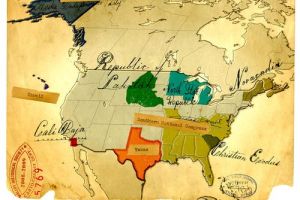
CHATTANOOGA, Tenn. - In an unlikely marriage of desire to secede from the United States, two advocacy groups from opposite political traditions — New England and the South — are sitting down to talk.
Tired of foreign wars and what they consider right-wing courts, the Middlebury Institute wants liberal states like Vermont to be able to secede peacefully. [snip]
Has anybody information on where all these “right-wing courts are? Secondly, Just how far bent to the left could the Middlebury Institute want in a court. How about a Star Chamber to clear up non-PC utterances and what, expunge rampant hate crime?
Flag of the Second Vermont Republic
If allowed to go their own way, New Englanders “probably would allow abortion and have gun control,” Hill said, while Southerners “would probably crack down on illegal immigration harder than it is being now.”
The U.S. Constitution does not explicitly prohibit secession, but few people think it is politically viable.
Vermont, one of the nation’s most liberal states, has become a hotbed for liberal secessionists, a fringe movement that gained new traction because of the Iraq war, rising oil prices and the formation of several pro-secession groups.
After secession, Vermont’s GNP will exceed only North Korea’s manufacturing excesses. As of now they cannot keep college grads here and business expansion will consist of Macramé and candle shoppes festooned with gingerbread gewgaws.
To these characters, running a business consists of running it into the ground. Then the elite will request the UN to send them rice and automatic weapons.
Thomas Naylor, the founder of one of those groups, the Second Vermont Republic, said the friendly relationship with the League of the South doesn’t mean everyone shares all the same beliefs. [snip]
The first North American Separatist Convention was held last fall in Vermont, which, unlike most Southern states, supports civil unions. Voters there elected a socialist to the U.S. Senate. [snip]
Yeah, between that embarrassment and the other bozo in the senate, a new state motto is needed. Perhaps, “Vermont, we’re all dysfunctional here.”
Secession is a legal political option that seeks to pull away from the central government. It does not seek to overthrow the government or rebel, only to pull away. It is not a move to overthrow the whole government, the people are excercising their right to leave their former association. Secession is not limited to states, it also occurs with counties, cities and neighborhoods. The concept of secession is often associated with nullification.
Nullification occurs when a political body nullifies a law imposed on it from another authority. The party nullifies the action, measure or law imposed from the higher authority. Nullification can be softcore, which is when the nullifying body chooses not to enforce the law or hardcore, which is when the nullifying body chooses to cancel out the law or measure.

/http%3A%2F%2Fimage.examiner.com%2Fimages%2Fblog%2Fwysiwyg%2Fimage%2Fsecede.jpg)
Escribió para El Polvorín Blog Malcolm Allison


/http%3A%2F%2Fwww.contrainjerencia.com%2Fwp-content%2Fuploads%2F2014%2F07%2Ftimthumb.php_1.jpg)
/http%3A%2F%2Fwww.radio36.com.uy%2Fentrevistas%2F2014%2F08%2F01%2Fclip_image002_0546.jpg)
/http%3A%2F%2Fwww.radio36.com.uy%2Fentrevistas%2F2014%2F08%2F01%2Fclip_image002_0545.jpg)
/http%3A%2F%2Fimg.youtube.com%2Fvi%2FIq04dnHwpYc%2F0.jpg)

